Feb 16, 2009

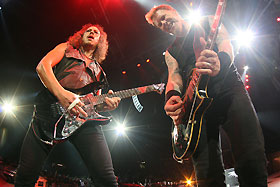
James Hetfield

James Hetfield
James Hetfield, September 15th 2008

Background information
Birth name James Alan Hetfield
Born August 3, 1963 (1963-08-03) (age 45),
Downey, California
Occupation(s) Musician, Songwriter, Producer
Instrument(s) Vocals, guitar, drums
Voice type(s) Baritone
Years active 1978–present
Label(s) Warner Bros., Elektra, Megaforce
Associated acts Metallica, Spastik Children,
Website www.metallica.com
Notable instrument(s)
ESP "Truckster" Signature model
ESP "Grynch" Signature model
James Alan Hetfield (born August 3, 1963, in Downey, California[1]) is the main songwriter, co-founder, vocalist and rhythm guitarist of the American heavy metal band Metallica.

Biography


Early life and family

James Hetfield was born on August 3, 1963, in Downey, Los Angeles County, California to a family of English, Irish, Scottish, and German descent.
James' father, Virgil (a truck driver who later left the family) and mother, Cynthia (a light opera singer) were devout and strict adherents to Christian Science, and accordingly, much of James' young life revolved around Christian Science.[2]
In accordance with their beliefs, Hetfield's parents strongly disapproved of medicine or any medical treatment and remained loyal to their faith even as Cynthia was dying from cancer.[2]

Musical influences

Cynthia's death and James' subsequently turbulent relationship with religion have both been the focal point of many Metallica lyrics throughout the years - the songs "Mama Said", "Dyers Eve" and "The God That Failed," are about Hetfield's parents, and "Until It Sleeps" is about cancer.[3]
Hetfield was nine years old when he first began piano lessons, after which he took on his brother David's drums and finally, at the age of fourteen, James began to learn to play guitar. [4]
James identifies Aerosmith as having been his main musical influence as a child, and has said that they were the reason why he wanted to play guitar. Other bands such as Motörhead, Black Sabbath, Diamond Head, Iron Maiden, Queen, Led Zeppelin and Thin Lizzy also had a major influence on his musical tastes.[3]

Pre-Metallica Bands

Hetfield formed his first band, Obsession, when he was in his early teens. The members of Obsession were:
  • The Veloz brothers on bass and drums,
  • Jim Arnold on guitar, and
  • James Hetfield on lead vocals
Obsession spent much time in the Veloz brothers' garage jamming, with Ron McGovney and Dave Marrs acting as roadies. Marrs and McGovney subsequently joined the band itself when the Veloz brothers quit.
After the death of his mother, James moved to Brea, California where he attended Brea Olinda High School and met up with drummer Jim Mulligan. The two jammed during lunch breaks, scaring fellow pupils with their loud and heavy music.
Hetfield's next band Phantom Lord was born with Tanner on guitar, Mulligan on drums, and Hetfield singing and playing guitar. The group went through a few bass players until graduation, when Hetfield moved back to Downey.[1]
Once back in Downey, Hetfield moved into a house owned by McGovney's parents that was slated for demolition due to an expressway expansion.
Hetfield talked McGovney into playing bass guitar, Phantom Lord disbanded, and then the third band under Hetfield's leadership, Leather Charm, was born. Hetfield no longer played guitar, McGovney played bass guitar, while Tanner and Mulligan retained their former Phantom Lord positions.
Leather Charm was largely a hard rock combo which played a few originals along with covers of songs such as Iron Maiden's "Remember Tomorrow". Hetfield would later go on to perform "Remember Tomorrow" with Metallica in 2008.
The band performed at a few parties and recorded a demo, but then began to fall apart.
Tanner left the band, to be replaced by Troy James, then Mulligan left for a more progressive, Rush-like band.
Without a drummer, the rest of the band decided to call it quits. It was Mulligan's departure that led to Hetfield searching for a new drummer. It was through a classified ad in a local newspaper, The Recycler, that Hetfield would meet Lars Ulrich. The two would form Metallica in 1981.

Metallica (1981-present)

In the early days of Metallica, Metallica experimented with a few different vocal/guitar configurations. Some of the options considered included adding another guitar player, having John Roads play lead guitar, as well as asking John Bush from Armored Saint (who later joined Anthrax) to sing for the band. The finalized line-up of the band became Hetfield (rhythm guitar and vocals), Lars Ulrich (drums), Dave Mustaine (lead guitar), and Ron McGovney (bass).

James Hetfield performing during the Damaged Justice tour.
From 1981 to 1983, Mustaine's famous rock and roll lifestyle sparked heated altercations between him and Hetfield. Mustaine also once poured beer into Ron McGovney's bass, very nearly causing serious damage. Eventually, Hetfield and Ulrich ejected Mustaine due to his alcoholic tendencies, and recruited lead guitarist Kirk Hammett from the band Exodus the same day. Mustaine was sent home on a 4-day bus journey, and went on to form the thrash metal band Megadeth.
Until the mid-1990s, Hetfield recorded all rhythm tracks and most harmony tracks. Since the recording of Load, Kirk Hammett is recording rhythm guitars as well. James occasionally plays guitar solos, too, such as "Nothing Else Matters", the outro solo on "The Outlaw Torn", the second solo on "To Live Is to Die", the second solo on "Orion" and the first interlude solo on "Master of Puppets". He also writes the majority of the guitar harmonies, as well as writing the lyrics, vocal melodies, and co-arranging the songs with Ulrich.
Hetfield has been involved in many onstage accidents, the most well-known being an incident with pyrotechnics at Montreal's Olympic Stadium. While on the GN'R-Metallica Stadium Tour in August 1992, he accidentally stepped into the path of one of the chemical flames that had been rigged to shoot from the lip of the stage during the Solo of "Nothing Else Matters". Hetfield's guitar protected him from the full force of the blast; however, the fire engulfed his left side, burning his hand, arm, eyebrows, face and hair. He suffered second, and third-degree burns, but was back on stage 17 days later, although his guitar duties were delegated to former guitar tech and Metal Church guitarist John Marshall for four weeks while he recovered.[5]
Hetfield has also broken his arm several times while skateboarding, which prevented him from playing guitar on stage, and subsequently caused Hetfield's management company Q Prime to add a clause in James' contract forbidding him to ride a skateboard during a Metallica tour.[6] During a concert supporting Metallica's Black Album, James blew his voice box out singing the cover song "So What" while still having a lot of Metallica songs to play, forcing him to take vocal lessons for the first time. James did basic warm-up exercises to piano keys with his vocal coach who also gave him a cassette tape of the piano warm-up for future use. Hetfield still uses the same cassette he was given in the early nineties to this day before any show or any recording Metallica does. James talks about his vocal training endevours in the Metallica documentary film, Some Kind of Monster produced & directed by Joe Berlinger & Bruce Sinofsky. [7]

Hetfield with Metallica Live in London 2003
During the recording of the St. Anger album (2002-2003), Hetfield went into rehab to address his alcohol addiction. Hetfield had long-standing issues with alcohol and the band's alcoholic tendencies had earned them the nickname "Alcoholica" by the music press. Hetfield rejoined the band after two months in rehab and seven months recovering with his family. He is now clean and sober and is determined to remain so, all of which is Some Kind of Monster. [8]
Some Kind of Monster also shows the making of the St. Anger album and documents the various conflicts and issues the band were facing at the time including the departure of Metallica's bassist, Jason Newsted, alcoholism, family commitments, and the future of the band with many in the rock press questioning whether the band would even still be together to see the completion of the St. Anger album.
Although St. Anger was seen by many as the weakest Metallica album to date, Hetfield, and the rest of Metallica, along with their new bassist, Robert Trujillo have addressed their many issues, and are continuing to make music. Metallica's newest album, Death Magnetic, was released on September 12, 2008. Like St. Anger and every album of original material released by Metallica since 1991's Black Album, Death Magnetic went #1 on the Billboard charts in over 30 countries during its first week of release.[9]

Personal life

When he is not writing, singing or playing, Hetfield enjoys a variety of outdoor activities including hunting, skateboarding, snowboarding, water and jet-skiing; sketching, working in his garage customizing cars and motorcycles, watching his favorite football team the Oakland Raiders, and going to hot-rod shows.
He also collects vintage guitars--particularly those from 1963--and enjoys working on classic automobiles. Among his favorites are a '74 Chevy Nova, which he helped restore, and "The Beast", an all-terrain four wheel drive Blazer.
He put his 1967 Chevrolet Camaro up for sale on eBay, with the proceeds going to a Music for Schools program. The car was used in the video for "I Disappear" and was given to him as a gift upon the video's completion. Years later, James donated the car to the Hard Rock Cafe which is featured in the movie Hard Rock Treasures.
Hetfield has several tattoos, including one which shows flames encasing four cards, - Ace (1), 9, 6 and 3 - representing the year of his birth, and the words "Carpe Diem" (Seize the Day, also part of the title of the track "Carpe Diem Baby" off ReLoad). The flames from the tattoo are reportedly in reference to the pyrotechnic accident he suffered from in 1992. He has also tattooed an 'M' on his hand which stands for Metallica.
Aside from these pursuits, Hetfield says he is often happiest spending time with his wife Francesca and their three children: Cali (13 June 1998), Castor (18 May 2000), and Marcella (17 January 2002). Hetfield married his wife Francesca Tomasi on August 17, 1997.
During an interview on NPR's Fresh Air, Hetfield stated that his wife had helped him to mature and learn to deal with his anger issues more constructively, explaining that after they met, his destructive tendencies embarrassed both of them. The Hetfield family currently resides in Marin County, CA.

Equipment


Guitars

Hetfield has been a major endorser of ESP guitars since the 1980s, and is best known for playing custom-made Explorer-style guitars with an EMG 81/EMG 60 set for pickups. His popularization of the models was considered by some to be a catalyst in Gibson's decision to sue ESP over loss of profits (Gibson originated the model in the late 1950s and has allowed other companies to build replicas).[citation needed]
Hetfield's main guitar from the early days was an inexpensive Flying V copy, used almost exclusively until about 1984 when he switched to the Gibson Explorer model. The most common Explorers were the white Gibson "More Beer!" Explorer, and the white ESP Explorer known as "EET FUK", featuring middle finger inlays. He also has a white Gibson Explorer which says "So what!"
During the mid-1990s, Hetfield also used his two signature ESP Flying V models, one with red flames and one with green flames. He also asked a friend to fix black and silver diamond-plate metal onto the surface of some of his ESP Explorer guitars
James ESP Signature Custom Guitars include:
  • JH-1 (Flying V with red/orange hotrod flames) - 200 Made
  • JH-2 (Black Diamond Plate Explorer) - 200 Made
  • JH-3 (Black ESP Eclipse with Pinstripe design) - 100 Made
  • Grynch (Baritone Viper with Green Hotrod flames) - 260+ Made
  • Truckster (ESP Eclipse- primer grey finish, sanded to show wear and other layers of paint underneath)
  • Iron Cross (Limited edition Eclipse made to look like the actual Gibson)
Hetfield's experiments, placements of stickers and modifications have resulted in the production of signature models by ESP guitars. He bought a black ESP LTD Viper baritone 300, installed an EMG Afterburner booster circuit, and asked a friend of his to paint green flames on it. This resulted in the limited edition "The Grynch" model guitar. He splashed some Killrust grey paint on an ESP Eclipse model guitar, installed EMG 81 & 60 pickups, moved the toggle switch to a lower position - which resulted in the signature model ESP "Truckster" guitar.
He also uses two custom-made Explorer model guitars, built by bass luthier Ken Lawrence. Occasionally, James will use Kirk's electric guitars in the studio, in particular his Fender Stratocasters and Telecasters, as well as his Tom Anderson Pro Am (which was used for the clean guitar intro of "Enter Sandman"). On tour, James plays a range of different guitars, including many of his custom ESP models, and several Gibson models.
James Hetfield's current tour guitars:
  • Gibson 1973 Les Paul Custom "Maltese Cross" - This has been James's main tour guitar since the St. Anger era. It is Black with Gold hardware, with a gold racing stripe and a gold Maltese cross on the body. [1]
  • Gibson Les Paul Custom - Purple satin. Used often on the "Madly in Anger" Tour. [2]
  • Gibson 1976 Explorer "Rusty" - Black satin body with Dot inlays. Rosewood Fingerboard, with EMG 60/81 Humbuckers and "Rusted" pickguard. [3]
  • Electra (Gibson copy) Flying V This was his main Guitar from the "Kill em all" album to the "Master of puppets album" and was recently used again on the "Death Magnetic" album. The guitar has plenty of "Beauty marks. After having the headstock snap off around '86 James switched to Explorers. In 2006/7 it was fixed by his tech and an exact replica was also made for him by ESP which he uses live.
  • Ken Lawrence Explorer #2 - Custom made by Northern Californian Luthier Ken Lawrence. It is the second of two Ken Lawrence Explorer's James ownes. It features a Mahogany body with a Quilted Bubinga Top, Modified Kenneth Lawrence headstock, Chechen Rear Cover Plate and Custom Sun-Ray inlays. [4]
  • ESP Truckster I - Hetfields's signature model guitar is based on the Gibson Les Paul. It has a Aged Primer Grey finish with multiple layers superimposed upon each other, skillfully sandpapered to create a "worn out' look. Gloss chrome Mechanical Sperzel. TonePros Rest. [5]
  • ESP Truckster II - Hetfields's signature model, but in a new Black finish. [6]
  • ESP Iron Cross - New for 2009, Hetfields's signature model guitar is based on his Gibson 1973 Les Paul Custom "Maltese Cross". James uses this as his main tour guitar on the World Magnetic Tour.It is Black on a Mahogany Body with a "Relic" finish, to create a "worn out' look. Destressed Mechanical Sperzel. TonePros Rest. [7]
  • ESP White Explorer #3 "Papa Het" - White body with a "Papa Het" drawing by Dirty Donny on the body. [8]
  • ESP Flying V - New ESP Custom Flying V (replica of his old Electra). It has a White finish with Rosewood fretboard. It was Used rarely on 2008 European Vacation Tour, but is used a lot on the World Magnetic Tour. [9]
  • ESP M-100FM
  • ESP Black Explorer - Black ESP Explorer with Dot inlays. [10]
  • ESP LTD "The Grynch" - Signature Guitar. Black with Green Flames on both the font and back of the body and handle. Used on the song "Frantic". James Takes two of these on tour, one as a backup. [11]
  • ESP Eclipse Custom "Tattoo" - ESP Custom Eclipse with a Black body, featuring illustrations of "Tattoos" on the body. Rosewood handle. It also had Maltese Cross Inlays and is only used occasionally in concert. [12]
  • ESP Eclipse Custom "Maltese Cross" - ESP Custom Eclipse, basically an almost exact replica of James's 1973 Gibson Les Paul "Maltese Cross", only it's not a Gibson Les Paul but an ESP Eclipse. Used on the World Magnetic Tour.[13]

Amplifiers & Cabinets

Hetfield used a ProCo Rat distortion pedal in combination with a modified Marshall 1959 SLP amplifier and Marshall 1960B 4x12 speaker cabinet (with Celestion Vintage 30s speakers), for the 1983 album Kill 'Em All. The amplifier was stolen in Boston, Massachusetts in early 1984, which partially influenced him to write the song "Fade to Black".
For Ride the Lightning in 1984, Hetfield used an Ibanez Tube Screamer TS-9 overdrive pedal in combination with a Marshall JMP2203 amplifier, and Marshall 1960B speaker cabinets. He equalized the tone so it would have as minimal midrange frequencies as possible.
By 1985, Hetfield had grown tired of the thin artificial sound of distortion pedals, as well as the typical use of the Marshall guitar amplifier. For the recording of 1986's Master of Puppets, he and Kirk Hammett bought a Mesa/Boogie MarkIIC+ amplifier, and slaved its preamp into his Marshall amplifier, resulting in a more natural-sounding strong powerful distortion tone. He further enhanced his rhythm guitar tone with B&B/Aphex Parametric Equalizers, mixing desk equalization, and triple-tracking of every rhythm part with slightly alternating guitar settings. This complex process resulted in an aggressive, strong, rich, and sustaining thrash guitar tone with reduced midrange frequencies but sharp treble frequencies and thick low frequencies.
Hetfield used a very similar process and equipment in 1988 for the recording of ...And Justice for All. He increased the tone by using Mesa/Boogie Studio and Quad preamps into Mesa/Boogie Strategy 400 poweramps while recording dual-layered tracks. In the process, he had dialed in so much low end into his tone, as well as lower midrange frequencies, that he partially masked the sound of Jason Newsted's bass tracks.
By 1990, along with the assistance of Bob Rock, Hetfield perfected the scooped-midrange studio tone that he had been seeking since 1983. He discovered that utilizing the midrange frequencies straight from a modified Marshall amplifier, layered over guitar tracks of his trusty Mesa/Boogie MarkIIC+ as well as the Mesa/Boogie MarkIV, plus an ADA MP-1 preamp and a Mesa/Boogie Strategy 400 poweramp, he would get a much thicker and richer tone. He enhanced the frequencies by enclosing his four Marshall 1960B speaker cabinets with foam walls and U-Haul blankets, and carefully phase-canceled particular frequencies with eight closely-positioned microphones and two ambient condenser microphones.
The majority of his clean tones come from a Roland JC-120 Jazz Chorus Guitar Amplifier.
In 1995, Hetfield had altered his tone by introducing lower-midrange frequencies, via the Mesa/Boogie Triple Rectifier amplifier. He began to use the Mesa/Boogie TriAxis preamplifer and Mesa/Boogie Strategy 400 poweramp, as he would continue to use live and in the studio to the current day. He also played around with Marshall amplifiers and the "hi-fi sounding" Wizard Modern Classic amplifier. He used this setup for recording the 1996 album Load, the 1997 album ReLoad, and the 1998 cover-songs album Garage Inc.. Garage Inc. in particular is rather prominent in the use of the Wizard amp.
For the recording of 2003's St. Anger, Hetfield had altered his tone again. He used his "live rack" equipment which consists of Mesa/Boogie TriAxis preamps and Mesa/Boogie Strategy 400 poweramps, but also used Marshall amplifiers, the Wizard vintage/modern, and the Diezel VH4. The St. Anger: Rehearsals DVD which accompanies the St. Anger album, as well as Metallica's covers of The Ramones songs "Commando", "53rd & 3rd", "Cretin Hop", and "Today Your Love, Tomorrow the World", and Metallica's performance at the induction of the band Black Sabbath into the Hall of Fame, are good examples of the Diezel VH4 tone.
Hetfield is currently trialling the Krankenstein and Revolution 1 amplifiers, along with his current rig of the Diezel VH4, Mesa/Boogie TriAxis preamp and Mesa/Boogie Strategy 400 poweramp, and Mesa/Boogie Triple Rectifier. He has also been seen using the Mesa/Boogie Mark IV amplifier in the studio.
In the new music video for "The Day That Never Comes" James is using two Mesa Boogie Stiletto Deuces with matching Mesa Boogie 4x12 Cabinets.
Here is a list of equipment James Hetfield has used through out his career with Metallica:

Accessories

  • Ernie Ball "Power Slinky" strings (11-48)
  • Jim Dunlop Tortex 0.88mm custom picks (green)
  • Ernie Ball Skinny Top Heavy Bottom (.10-.52) Strings
  • Prototype Levy Straps-M7GG3.
  • Levy M8P3GP Straps
  • Peterson Strobe 420 Tuner
  • EMG 81 in bridge position
  • EMG 60 in neck position

Guest appearances

Read More >>

Lars Ulrich


Lars Ulrich di Praha, 2004.

Lars Ulrich (lahir 26 Desember 1963 di Gentofte, Denmark) adalah drummer kelompok Metallica. Ayahnya adalah pemain tenis profesional dan musikus jazz Torben Ulrich yang bermain musik jazz bersama Stan Getz dan Miles Davis. Lars Ulrich mengikuti jejak ayahnya di kedua bidang ini, bermain tenis sejak kecil dan belajar main musik.

Tapi minat musiknya kemudian beralih setelah mendengar banyak kelompok musik dari the New Wave of English Heavy Metal (gelombang baru musik heavy metal dari Inggris). Pada usia sembilan tahun ia kemudian pergi menonton konser kelompok Deep Purple dan menjadi fan drummer Ian Paice. Ketika berusia tigabelas tahun ia mendapat satu set drum dari neneknya dan mulai berlatih dengan serius.

Empat tahun kemudian ia pergi ke Los Angeles, California, Amerika dengan niat untuk bermain tenis. Ia kemudian memasang iklan baris di salah satu koran lokal dan mendapat jawaban dari James Hetfield. Berdua mereka kemudian menjadi inti kelompok Metallica.

Read More >>

Feb 14, 2009

Audioslave


Langsung ke: navigasi, cari
Audioslave
ki-ka: Tim Commerford, Chris Cornell, Brad Wilk, Tom Morello
Latar belakang
Asal Los Angeles, California
Genre Hard rock
Alternative rock
Post-grunge
Tahun aktif 2001–2007
Perusahaan rekaman Epic
Interscope
Terkait
dengan
Soundgarden
Rage Against the Machine
Temple of the Dog
The Nightwatchman
Class of '99
Puscifer
Situs web www.audioslave.com
Mantan anggota
Chris Cornell
Tom Morello
Tim Commerford
Brad Wilk

Audioslave adalah kelompok musik alternative rock AS yang terdiri dari mantan musisi Rage Against the Machine; Tom Morello (gitar), Tim Commerford (bass), dan Brad Wilk (drums), dan mantan penyanyi Soundgarden, Chris Cornell. Mereka dibentuk di Los Angeles, California pada 2001, setelah bubarnya RATM. Audioslave adalah band AS pertama yang mengadakan konser di Kuba secara gratis untuk sekitar 50.000 penonton pada 6 Mei 2005.

Setelah menerbitkan tiga album, menerima tiga nominasi Grammy, dan menjual 8 juta keping rekaman di dunia, Chris Cornell menyatakan keluar dari band tersebut. Hal ini dilakukan sekitar sebulan setelah Morello, Commerford, dan Wilk menyatakan diri bergabung kembali dengan penyanyi Zack de la Rocha untuk membentuk kembali RATM. Selain itu baik Morello maupun Cornell menerbitkan album solo pada 2007, sehingga Audioslave saat ini praktis bubar.

Diskografi

Terbit Judul Label
19 November 2002 Audioslave Epic
24 Mei 2005 Out of Exile Interscope
5 September 2006 Revelations Epic
Read More >>

The Clash


The Clash
The Clash live in Oslo, 1980
Background information
Origin London, England
Genre(s) Punk rock, various others
Years active 1976–1986
Label(s) CBS
Associated acts The 101'ers, London SS, Generation X, Big Audio Dynamite, Havana 3am, The Latino Rockabilly War, The Pogues, The Mescaleros, Carbon/Silicon, The Good, the Bad and the Queen
Website www.theclash.com
Former members
Mick Jones
Paul Simonon
Terry Chimes
Joe Strummer
Nicky "Topper" Headon
Keith Levene
Rob Harper
Pete Howard
Nick Sheppard
Vince White

The Clash were an English rock band that formed in 1976 as part of the original wave of British punk rock. Along with punk rock, they experimented with reggae, ska, dub, funk, rap and rockabilly. For most of their recording career, The Clash consisted of Joe Strummer (lead vocals, rhythm guitar), Mick Jones (lead guitar, vocals), Paul Simonon (bass, backing vocals, occasional lead vocals) and Nicky "Topper" Headon (drums, percussion). Headon left the group in 1982, and internal friction led to Jones's departure the following year. The group continued with new members, but finally disbanded in early 1986.

The Clash were a major success in the UK from the release of their self-titled debut album in 1977. Their third album, London Calling, released in the UK in December 1979, brought them popularity in the United States when it came out there the following month. It received wide critical acclaim; a decade later Rolling Stone magazine declared it the best album of the 1980s.[1]

The Clash's politicised lyrics, musical experimentation, and rebellious attitude had a far-reaching influence on rock, alternative rock in particular.[2] They became widely referred to as "The Only Band That Matters", originally a promotional slogan introduced by the group's record label, CBS. In January 2003 the band—including original drummer Terry Chimes—were inducted into the Rock and Roll Hall of Fame. In 2004, Rolling Stone ranked The Clash number 30 on their list of the 100 Greatest Artists of All Time.[3]

History

Prehistory and formation: 1974–1976

Before The Clash's founding, the band's future members were active in different parts of the London music scene. John Graham Mellor sang and played rhythm guitar in the pub rock act The 101'ers, which formed in 1974. By the time The Clash came together two years later, he had already abandoned his original stage name, "Woody" Mellor, in favor of "Joe Strummer", a reference to his rudimentary strumming skills on the ukulele as a busker in the London Underground. Mick Jones played guitar in legendary protopunk band London SS, which rehearsed for much of 1975 without ever playing a live show and recording only a single demo. London SS was managed by Bernard Rhodes, a sometime associate of impresario Malcolm McLaren and a friend of the band McLaren managed, the Sex Pistols, who made their public debut in November. Among those who auditioned for London SS without making the cut were Paul Simonon, who tried out as a vocalist,[4] and drummer Terry Chimes. Nicky Headon drummed with the band for a week, then quit.[5]

After London SS broke up in early 1976, Rhodes continued as Jones's manager. At the instigation of Rhodes, Jones contacted Simonon in March, suggesting he learn an instrument so he could join the new band Jones was organising.[4] Soon Jones, Simonon on bass, Keith Levene on guitar and "whoever we could find really to play the drums" were rehearsing.[6] In late May, Chimes was asked to audition and became the band's full-time drummer.[7]

The act was still searching for a lead singer. Rhodes had his eye on Strummer, with whom he made exploratory contact. Strummer, for his part, was primed to make the switch. In April, he had taken in the opening act for one of his band's gigs. That act was the Sex Pistols. "I knew something was up," Strummer later explained,

so I went out in the crowd which was fairly sparse. And I saw the future—with a snotty handkerchief—right in front of me. It was immediately clear. Pub rock was, "Hello, you bunch of drunks, I'm gonna play these boogies and I hope you like them." The Pistols came out that Tuesday evening and their attitude was "Here's our tunes, and we couldn't give a flying fuck whether you like them or not. In fact, we're gonna play them even if you fucking hate them."[8]

On 30 May, Rhodes and Levene met surreptitiously with Strummer after a 101'ers gig. Rhodes gave him 48 hours to make up his mind whether he wanted to join the new band that would "rival the Pistols". When Rhodes rang him up a day early, demanding an immediate answer, Strummer agreed.[9] Simonon later remarked, "Once we had Joe on board it all started to come together."[6]

Strummer and Jones shared most of the writing duties. Strummer took the lead vocals on the majority of songs; in some cases he and Jones shared the lead. Once the band began recording, Jones would rarely have a solo lead on more than one song per album, but he would wind up responsible for two of the group's biggest hits. Simonon—who eventually sang lead on a few songs—came up with the band's name after they had considered alternatives including The Weak Heartdrops and The Psychotic Negatives.[10][11] Simonon explained the name's origin: "It really came to my head when I start reading the newspapers and a word that kept recurring was the word 'clash', so I thought 'The Clash, what about that,' to the others. And they and Bernard, they went for it."[10]

After rehearsing with Strummer for less than a month, The Clash made their debut on 4 July 1976, supporting the Sex Pistols at the Black Swan in Sheffield. The band apparently wanted to make it onstage before their rivals in The Damned—another London SS spinoff—made their own scheduled debut two days later. The Clash would not play out again for another five weeks.[12] In early September, Levene was kicked out for never showing up to practice.[13] On 21 September, the band performed at the 100 Club Punk Festival, sharing the bill with the Sex Pistols, Siouxsie and the Banshees and Subway Sect.[14] Chimes left in late November; he was briefly replaced by Rob Harper as The Clash toured in support of the Sex Pistols during December's Anarchy Tour.[15]

Debut and Give 'Em Enough Rope: 1977–1978

By the turn of the year, punk had become a major media phenomenon in the UK. On 25 January 1977, The Clash signed to CBS Records for £100,000, a remarkable amount for a band that had played a total of about thirty gigs and almost none as a headliner.[16] As Clash historian Marcus Gray describes, the "band members found themselves having to justify [the deal] to both the music press and to fans who picked up on the critics' muttered asides about The Clash having 'sold out' to the establishment."[17] Mark Perry, founder of the leading London punk periodical, Sniffin' Glue, let loose with what he would later call his "big quote": "Punk died the day The Clash signed to CBS."[18]

Mickey Foote, who worked as a technician at their concerts, was hired to produce The Clash's debut album, and Terry Chimes was drafted back for the recording. The band's first single, "White Riot", was released in March; the album, The Clash, came out the following month. Filled with fiery punk tracks, it also presaged the many eclectic turns the band would take with its cover of the reggae song "Police and Thieves". Though both the single and album charted well in the UK—"White Riot" reached number 34, The Clash number 12—CBS refused to release either in the United States, saying that the sound was not “radio friendly”.[13] A US version of the album with a modified track listing was released in 1979, after the UK original became the best-selling import album of all time in the United States.[19] Chimes left the band again soon after the recording, so only Simonon, Jones and Strummer were featured on the album's cover, and Chimes was credited as "Tory Crimes". In the documentary Westway to the World, Jones referred to him as one of "the best drummers around". Chimes, who had no great wish to make a career from music, said, "The point was that I wanted one kind of life—they wanted another, and why are we working together, if we want completely different things?"[13]

The band went through several drummers, with Jones handling the duties for a time.[20] They finally recruited Nicky Headon, who had played briefly with Jones's London SS two years before. Headon was nicknamed "Topper" by Simonon, who felt he resembled the Topper comic book character Mickey the Monkey. An excellent musician, Headon could also play piano, bass and guitar. He originally planned to stay briefly, gain a name for himself, and then find a better band. Realising The Clash's potential, he changed his plans. In Westway To The World, Strummer noted, "If we hadn't found Topper, I don't think we'd have got anywhere".[13] Headon's first recording with the band was the single "Complete Control"; it was produced by famed reggae artist Lee "Scratch" Perry, but the result was pure punk rock. Released in September 1977, it rose to number 28 on the British chart and has gone on to be cited as one of punk's greatest singles.[21] During this period, members of The Clash were arrested for various misdemeanors ranging from vandalism to the stealing of a pillowcase.[2]

In February 1978, the band came out with the single "Clash City Rockers". June saw the release of "(White Man) in Hammersmith Palais", which surprised fans with its ska rhythm and arrangement. Before The Clash began recording their second album, CBS requested that they adopt a cleaner sound than its predecessor in order to reach American audiences. Sandy Pearlman, known for his work with Blue Öyster Cult, was hired to produce the record. Although some complained about its relatively mainstream production style, Give 'Em Enough Rope received largely positive reviews upon its November release.[22] It hit number 2 in the UK, but it was not the American breakthrough CBS had hoped for, reaching only number 128 on the Billboard chart. The album's first UK single, the hard rocking "Tommy Gun", rose to number 19, the highest chart position for a Clash single to date. In support of the album, the band undertook its first, largely successful tour of the US.

London Calling, Sandinista! and Combat Rock: 1979–1982

In August and September 1979, The Clash recorded London Calling. Produced by Guy Stevens, who had previously worked with Mott the Hoople and others, the double album was a mix of punk rock, reggae, ska, rockabilly, traditional rock and roll and other elements possessed of an energy that had hardly flagged since the band's early days, but with greater maturity and production polish.[23][24] It is regarded as one of the greatest rock albums ever recorded.[25] London Calling reached number 9 on the British chart and number 27 on the US chart. Its final track, a relatively straightforward rock and roll number sung by Mick Jones called "Train in Vain", was included at the last minute and thus did not appear in the track listing on the cover. It turned out to be their first US Top 40 hit, peaking at number 23 on the Billboard chart. In the UK, where "Train in Vain" was not released as a single, London Calling's title track, stately in beat but unmistakably punk in message and tone, rose to number 11—the highest position any Clash single reached in the UK before the band's breakup. During this period, The Clash began to be regularly billed as "The Only Band That Matters". Musician Gary Lucas, then employed by CBS Records' creative services department, claims to have coined the tagline.[26] The epithet was soon widely adopted by fans and music journalists.[27]

The Clash planned to record and release a single every month in 1980. CBS balked at this idea, and the band came out with only one single—an original reggae tune, "Bankrobber", in August—before the December release of the 3-LP, 36-song Sandinista!. The album again reflected a broad range of musical styles, including extended dubs and the first forays into rap by a major rock band. Produced by the band members with the participation of Jamaican reggae artist Mikey Dread, Sandinista! was their most controversial album to date, both politically and musically.[28] Critical opinion was divided, often within individual reviews. Trouser Press's Ira Robbins described half the album as "great", half as "nonsense" and worse.[29] In the New Rolling Stone Record Guide, Dave Marsh argued, "Sandinista! is nonsensically cluttered. Or rather seems nonsensically cluttered. One of the Clash's principal concerns...is to avoid being stereotyped."[30] The album fared well in America, charting at number 24,[31] even though it had no catchy single and, in the increasingly conservative environment of album-oriented rock (AOR) radio in the US, received minimal airplay.[13]

During 1981, the band came out with a single, "This Is Radio Clash", that further demonstrated their ability to mix diverse influences such as dub and hip hop. They set to work on their fifth album in the fall, originally planning it as a 2-LP set with the title Rat Patrol from Fort Bragg. Mick Jones produced one cut, but the other members were dissatisfied. Production duties were handed to Glyn Johns, and the album was reconceived as a single LP. Though Combat Rock was filled with offbeat songs, experiments with sound collage, and a spoken word vocal by Beat poet Allen Ginsberg, it contained two "radio friendly" tracks. The leadoff single in the US was "Should I Stay or Should I Go", released in June 1982. Another Jones feature in a rock and roll style similar to "Train in Vain", it received heavy airplay on AOR stations. The follow-up, "Rock the Casbah", put lyrics addressing the Iranian clampdown on imports of Western music to a bouncy dance rhythm. (The singles were released in the opposite order in the UK, where they were both preceded by "Know Your Rights".) The music for "Rock the Casbah" was composed by Headon, who performed not only the percussion but also the piano and bass heard on the recorded version.[32] It was the band's biggest US hit ever, charting at number 8, and the video was put into heavy rotation by MTV.[13] The album itself was the band's most successful, hitting number 2 in the UK and number 7 in the US.

Disintegration: 1982–1984

After Combat Rock, The Clash began to disintegrate. Topper Headon was asked to leave the band just prior to the release of the album, due to his heroin addiction, which was damaging his health and drumming.[13][33] The band's original drummer, Terry Chimes, was brought back for the next few months. The loss of Headon, well-liked by the others, exposed the growing frictions within the band. Jones and Strummer began to feud. The band opened for The Who on a leg of their final tour in the US, playing (among other places) New York's Shea Stadium.[13] Though The Clash continued to tour, the personal tensions were increasing.[13]

In early 1983, Chimes left the band after the end of the Combat Rock Tour, due to the in-fighting and turmoil. He was replaced by Pete Howard for the US Festival in San Bernardino, California, which The Clash co-headlined, along with David Bowie and Van Halen. The band argued with the event's promoters over inflated ticket prices, threatening to pull out unless a large donation was made to a local charity. The group ultimately performed on May 28, the festival's New Music Day, which drew a crowd of 140,000. After the show, members of the band brawled with security staffers.[34] This was Jones's last appearance with the group. In September 1983, he was fired. The following year, he played guest guitar on the debut album by General Public.

Nick Sheppard, formerly of the Bristol-based Cortinas, and Vince White were selected as The Clash's new guitarists. Howard continued as the drummer. The reconstituted band played its first shows in January 1984 with a batch of new material and launched into the self-financed Out of Control Tour, traveling widely over the winter and into early summer. At a striking miners' benefit show ("Scargill's Christmas Party") in December 1984, they announced that a new record would be released early in the new year.

Cut the Crap, final breakup, and aftermath: 1985–1991

The recording sessions for Cut the Crap were chaotic, with manager Bernard Rhodes and Strummer working in Munich. Most of the music was played by studio musicians, with Sheppard and later White flying in to provide guitar parts. Struggling with Rhodes for control of the band, Strummer returned home. The band went on a busking tour of public spaces in cities throughout the UK, playing acoustic versions of their hits and popular cover tunes.

After a gig in Athens, Strummer went to Spain to clear his mind. While he was abroad, the first single from Cut the Crap, the mournful "This Is England", was released to mostly negative reviews. "CBS had paid an advance for it so they had to put it out", Strummer later explained. "I just went, 'Well fuck this', and fucked off to the mountains of Spain to sit sobbing under a palm tree, while Bernie had to deliver a record."[8] However, critic Dave Marsh later championed "This Is England" as one of the top 1001 rock singles of all time.[35] The single has also received retroactive praise from Q magazine and others.

"This Is England", much like the rest of the album that came out later that year, had been drastically re-engineered by Rhodes, with synths and football-style chants added to Strummer's incomplete recordings. Although Howard was an adept drummer, drum machines were used for virtually all of the percussion tracks. For the remainder of his life, Strummer largely disowned the album,[33] although he did profess that "I really like 'This is England' [and album track] 'North and South' is a vibe."[8] Other songs played on the tour remain unreleased to this day, including "Jericho" and "Glue Zombie". The Clash effectively disbanded in early 1986.[24]

After the breakup, Strummer contacted Jones in an effort to reform The Clash. Jones, however, had already formed a new band, Big Audio Dynamite (B.A.D.), that had released its debut late in 1985. The two did work together on their respective 1986 projects. Jones helped out with the two songs Strummer wrote and performed for the Sid and Nancy soundtrack. Strummer, in turn, cowrote a number of the tracks on the second B.A.D. album, No. 10, Upping St., which he also coproduced.[8] With Jones committed to B.A.D., Strummer moved on to various solo projects and screen acting work. Simonon formed a band called Havana 3am. Headon recorded a solo album, before once again spiraling into drug abuse. Chimes drummed with a succession of different acts.

On 2 March 1991, a reissue of “Should I Stay or Should I Go” gave The Clash its first and only number 1 UK single. That same year, Strummer reportedly cried when he learned that "Rock the Casbah" had been adopted as a slogan by US bomber pilots in the Gulf War.[36]

Collaborations and reunions: 1999–present

In 1999, Strummer, Jones and Simonon cooperated in the compiling of the live album From Here to Eternity and video documentary Westway to the World. On 7 November 2002, the Rock and Roll Hall of Fame announced that The Clash would be inducted into the Hall the following spring.[37] On 15 November, Jones and Strummer shared the stage, performing three Clash songs during a London benefit show by Joe Strummer and the Mescaleros.[31] Strummer, Jones and Headon wanted to play a reunion show to coincide with their induction into the Hall. Simonon, however, did not want to participate because he believed that playing at the high-priced event would not have been in the spirit of The Clash. At any rate, Strummer's death from a congenital heart defect on 22 December 2002 prevented any potential reunion. In March 2003, the Hall of Fame induction took place; the band members inducted were Strummer, Jones, Simonon, Chimes and Headon.[31] In 2004, Rolling Stone ranked The Clash number 30 on their list of the 100 Greatest Artists of All Time.[3]

In early 2008, Carbon/Silicon, the new band founded by Mick Jones and his former London SS bandmate Tony James, entered into a six-week residency at London's Inn on the Green. On opening night, 11 January, Headon joined the band for The Clash's "Train in Vain". An encore followed with Headon playing drums on "Should I Stay or Should I Go". This was the first time since 1982 that Headon and Jones had performed together on stage.[38]

[edit] Politics

The band's music was often charged by a leftist political ideology.[39] Joe Strummer, in particular, was a committed leftist. The Clash are credited with pioneering the advocacy of radical politics in punk rock, and were known as the "Thinking Man's Yobs" by many simply for voicing a political slant other than anarchism.[40] Like many early punk bands, The Clash protested against monarchy and aristocracy. However, unlike many of their peers, The Clash rejected nihilism.[19] Instead, they found solidarity with a number of contemporary liberation movements and were involved with such groups as the Anti-Nazi League. Their politics were made explicit in the lyrics of such early recordings as "White Riot", which encouraged disaffected white youths to become politically active like their black counterparts; "Career Opportunities", which addressed the alienation of low-paid, routinised jobs and discontent over the lack of alternatives; and "London's Burning", about the bleakness and boredom of life in the inner city.[24] Artist Caroline Coon, who was associated with the punk scene, argued that "[t]hose tough, militaristic songs were what we needed as we went into Thatcherism".[41]

In April 1978, The Clash headlined the Rock Against Racism concert in London's Victoria Park for 80,000 people,[13][42] where Strummer wore a T-shirt bearing the words "Brigade Rosse" with the Red Army Faction (Baader-Meinhof) insignia in the middle.[43] He later said that he wore the shirt not to support the violent left-wing factions in Italy and Germany, but to bring attention to their existence.

The band's political sentiments were reflected in their resistance to the music industry's usual profit motivations; even at their peak, tickets to shows and souvenirs were reasonably priced.[19] The group insisted that CBS sell their double and triple album sets London Calling and Sandinista! for the price of a single album each (then £5), succeeding with the former and compromising with the latter by agreeing to sell it for £5.99 and forfeit all their royalties on its first 200,000 sales.[13][20] These "VFM" (value for money) principles meant that they were constantly in debt to CBS, and only started to break even around 1982.[1]

Legacy and influence

In Rolling Stone's 2004 list of the 500 greatest songs of all time, "London Calling" ranked number 15, the highest for any song by a punk band. Four other Clash songs made the list: "Should I Stay Or Should I Go" (228), "Train In Vain" (292), "Complete Control" (361), and "White Man In Hammersmith Palais" (430).[44] "London Calling" ranked number 48 in the magazine's 2008 list of the 100 greatest guitar songs of all time.[45] In the magazine's 2003 list of the 500 greatest albums of all time, London Calling ranked number 8, again the highest entry by a punk band. The Clash was number 77 and Sandinista! was number 404.[46]

The Clash's influence can be heard in American political punk bands such as Rancid, Morning Glory, and Anti-Flag , as well as in the political hard rock of early Manic Street Preachers. Rancid in particular is known for a Clash obsession. The band's song "Indestructible" includes the line, "And I'll keep listening to the great Joe Strummer / 'Cause through music we can live forever". U2 also has acknowledged the influence of The Clash. Many Latin American post-punk and ska/reggae/dub bands such as Mano Negra, Todos Tus Muertos, Skalariak and Maldita Vecindad are also indebted to The Clash. Argentina's Los Fabulosos Cadillacs covered "Revolution Rock", and Mick Jones sings on their "Mal Bicho".

Members

1976
1976
  • Joe Strummer – lead vocals, rhythm guitar
  • Mick Jones – lead guitar, backing vocals
  • Paul Simonon – bass guitar, backing vocals
  • Terry Chimes – drums, percussion
1976
  • Joe Strummer – lead vocals, rhythm guitar
  • Mick Jones – lead guitar, backing vocals
  • Paul Simonon – bass guitar, backing vocals
  • Rob Harper – drums, percussion
1977
  • Joe Strummer – lead vocals, rhythm guitar
  • Mick Jones – lead guitar, backing vocals
  • Paul Simonon – bass guitar, backing vocals
  • Terry Chimes – drums, percussion
1977-1982
Classic line-up
  • Joe Strummer – lead vocals, rhythm guitar
  • Mick Jones – lead guitar, backing vocals
  • Paul Simonon – bass guitar, backing vocals
  • Topper Headon – drums, percussion
1982-1983
  • Joe Strummer – lead vocals, rhythm guitar
  • Mick Jones – lead guitar, backing vocals
  • Paul Simonon – bass guitar, backing vocals
  • Terry Chimes – drums, percussion
1983
  • Joe Strummer – lead vocals, rhythm guitar
  • Mick Jones – lead guitar, backing vocals
  • Paul Simonon – bass guitar, backing vocals
  • Pete Howard – drums, percussion
1983-1986
  • Joe Strummer – lead vocals, rhythm guitar
  • Nick Sheppard – lead guitar, backing vocals
  • Vince White – lead guitar
  • Paul Simonon – bass guitar, backing vocals
  • Pete Howard – drums, percussion

Discography

Main article: The Clash discography
Year Title
1977 The Clash
1978 Give 'Em Enough Rope
1979 London Calling
1980 Sandinista!
1982 Combat Rock
1985 Cut the Crap
Read More >>